Free shipping in the U.S. — Click here for details .
Sign in Join now
Lightspeed AviationLightspeed AviationLightspeed AviationLightspeed Aviation
    0
  •   was successfully added to your cart.
  • Shop
    • All Products
    • Headsets
    • ANR Kit for Helmets
    • Flight Bags
    • Accessories
    • Lightspeed Aviation App
    • Lightspeed App
    • FlightLink App
    • Authorized Dealers
    • Trade Up Program
  • About
    • About Lightspeed
    • Programs
    • Lightspeed Delta Zulu® Saves Lives
    • Awards and Accolades
    • Patents
    • Careers
    • Associations
  • Community
    • All Posts
    • Blog Posts
    • Events
    • News
    • Sponsorships
  • Support
    • My Account
    • Customer Support
    • Repair Request
    • Frequently Asked Questions
    • Shipping and Return Policies
  • Contact
    • Contact Lightspeed
    • Corporate Inquiries
    • Authorized Dealers
    • Donation Requests
    • Media Kit
Sign in / Create Account

ANR 201: Section 2 – Passive vs. Active

    Home ANR ANR 201: Section 2 – Passive vs. Active
    NextPrevious

    ANR 201: Section 2 – Passive vs. Active

    By Lightspeed Aviation | ANR, ANR 201, Blog Posts | 0 comment | 9 November, 2003 | 0

    Passive vs. Active

    Understanding and comparing cancellation specifications

    Section 1 of this series dealt with different components that influence ‘quietness’.

    The focus of this session is to show what passive and active attenuation are and how they affect the total cancellation.

    Before going any farther, let me cover what we mean when using the terms “Passive” and “Active” attenuation. We use these words to describe how much noise is eliminated by the ‘physical’ characteristics of the headset (passive) and how much is reduced via the ‘electronic’ cancellation (active) generated within each dome. This cancellation can be measured and graphed…typically using noise levels (in dB) on one axis and frequency on the other. These characteristics are unique to each headsets style/shape/design. These two attenuations, when graphed and overlaid, form the basis for any claims of ‘total’ cancellation.

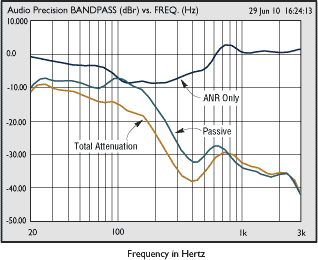
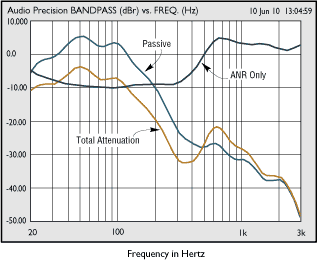
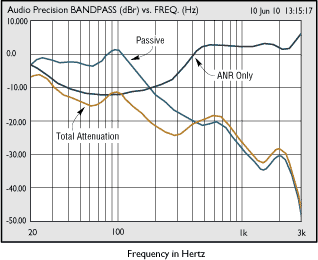
    Before we address the issue of advertised claims on various models, let’s look and compare data on cancellation for different products. Below is a set of attenuation graphs for three different headset designs. For each platform, the graph lines show Active performance, Passive only, and a third line showing the combined or Total Attenuation.

    Headset #1
    LSA_ANR_201_sec2

    Headset #2

    LSA_ANR_201_sec2_2

    Headset #3

    LSA_ANR_201_sec2_3

    There are several interesting things worth noting about these results. Headset graph #1 with the greatest active performance is actually the WORST for Total Attenuation. Headset graph #2 provides the lowest Active performance yet yields the BEST overall quieting! We’ll cover the reasons for this later on in this tutorial. The headset on graph #3 is quieter than #1 at frequencies above 300Hz but the passive performance was severely compromised by the conversion to an active product.

    What about just adding the active and passive claims together to determine which is quieter?

    This is a misleading practice and leads to false conclusions. The reasons for this were covered in some detail at the end of Section 2 of ANR 101. In summary, the active number is typically a single dB number that represents a frequency where active reduction is maximized. This ignores the breadth of cancellation provided and overlooks both positioning of the cancellation and boosting issues (both covered in some detail in Section 1 of ANR101). Typically manufacturers advertise a ‘range’ of peak cancellation as a reference. Depending on the test fixturing and measurement techniques, there can be substantial differences in results. Remember (from ANR101, Sec 1) the importance of good correlation between the sensing mic and your ear canal. The positioning of this mic effects the measured results for cancellation. It might cancel great at the microphone but not as much in your ear! In the final analysis, those numbers are only somewhat helpful in comparing different brands but ONLY for their active performance.

    Passively, the story gets even more confusing. First, a bit of history on the passive noise reduction ‘standard’. In the traditional ‘passive’ headset market, there has been a longstanding test standard set up by the EPA as an industrial standard for measuring hearing protection…the “Noise Reduction Rating” (NRR). This was the most popular means of comparison for passive headsets in the 80’s and 90’s. Today, most passive headsets make some claim about passive noise reduction. In reality, less than half of the models sold actually have test data to support their claim. Many publish a number like ” 24dB” but make no “NRR” claim. Others do imply some “NRR” rating but have no specific, by Model, test data. Recently others have published a “SNR” number…a attenuation rating system gaining popularity in Europe. While not inappropriate, these numbers become misleading since “SNR” tests routinely will produce higher dB reduction numbers than traditional “NRR” measurements.

    This information (or lack there of) becomes important when trying to assess the passive performance of the ANR models available on the market. As of this printing, no supplier had actually published “NRR” data for the passive performance of their ANR headset. One reason might be that the passive performance goes down NOTICEABLY when a passive headset is modified to become an active one. We’ll cover the acoustic reasons for that in more detail in Section 3. Suppliers might be reluctant to acknowledge that reduction openly…it wouldn’t help sell headsets!! Instead, those that had a passive model will reference their claims for passive performance without actually saying that it IS the passive performance. i.e. “We’ve added 14 dB of active performance to our 23dB NRR passive headset” Notice they don’t actually SAY their ANR model has 23dB NRR rating…but it’s implied.

    Test data between Active and Non-Active versions of identical platforms (covered in the next section) prove this point. At specific frequencies, the deviation can exceed 10dB. The reduction in passive attenuation of the ANR version will depend on how the active electronics module is implemented inside the dome(s). On average the Noise Reduction Rating (NRR) of the active version would be 2-6dB less than it’s passive version.

    I’m sure you’re beginning to see why confusion abounds in adding active and passive numbers. The active number…while technically accurate, provides only a partial indication of how effective the overall ANR electronics are. The passive numbers are flawed because there are no actual NRR ratings and then for some, the rating referenced wasn’t even an actual measure of the passive platform! Without being redundant, the only sure way to get good comparative data is to try on several models and compare them side by side. That can be done at major trade shows, or some of the larger pilot supply stores, or possibly by meeting up with fellow pilots who already have ANR headsets.

    Section 3 of this series deals with the acoustic tradeoffs relating to Active and Passive performance. It specifically deals with Ear cavity volume and Ear Seal design/comfort.

    Go to Section 3 >>

    ANR, ANR performance, anti-noise, attenuation, conforming ear seal, dome, ear cavity, ear seal, noise profile, passive, passive noise, side compression, sound wave, speaker, volume

    Lightspeed Aviation

    Lightspeed Aviation is a leading manufacturer of premium aviation headsets and helmet products. Since the first product was introduced in 1996 at AirVenture in Oshkosh, WI., the company has established a reputation for leading innovation in the aviation headset marketplace with a number of “first to market” advances, technologies, and features. In 2022, the company launched a new category of aviation products called “Safety Wearables”. Layering life-saving technologies on top of their award-winning audio and ANR platform, Lightspeed ushered in a new era of aviation safety. With this, the company continues to live its mission of “creating products that protect and save lives”. Additionally, Lightspeed is a passionate supporter of initiatives to encourage the next generation of pilots through its support of programs like Young Eagles and Ray Scholars. The company is proud to have participated in helping countless young people experience everything from a discovery flight to getting a Pilot Certificate.

    More posts by Lightspeed Aviation

    Related Posts

    • ANR 201: Section 4 – Conclusion

      By Lightspeed Aviation | 0 comment

      Conclusion   Section 3 of this series dealt with the physical characteristics of headsets and their effect on performance. The focus of this session discusses the emergence of two basic classes from what we’ve learned.Read more

    • ANR 201: Section 3 – Acoustic Design Tradeoffs

      By Lightspeed Aviation | 0 comment

      Acoustic Design Tradeoffs Section 2 of this series dealt with passive and active attenuation and how they affect the total cancellation. The focus of this session discusses the physical characteristics of headsets and their effectRead more

    • ANR 201: Section 1 – What Factors Make a Headset the Quietest?

      By Lightspeed Aviation | 0 comment

      Section 1: What factors make a headset the quietest? The most frequently asked unanswerable question remains: Which headset is quietest? This is a very subjective question that only partially depends on the characteristics of theRead more

    • ANR 201: The Quest for MAXIMUM Quiet

      By Lightspeed Aviation | 0 comment

      The Quest for MAXIMUM quiet! by the technical staff of Lightspeed Aviation Since ANR 101 was first published over 4 years ago, we’ve learned a lot about the personal preferences of pilots. The intention ofRead more

    • ANR for Helmets by SocialFlight’s T-51 Mustang Aircraft Build

      By Lightspeed Aviation | 0 comment

      Our friends over at SocialFlight have been hard at work with their T-51 Mustang Aircraft Build. So when they took a minute to discuss their helmets from FlightHelmet.com with the Zulu H-Mod installed, we took notice.Read more

    NextPrevious

    Recent Posts

    • Profiles in Early Flight – Ray Scholar Stories September 2024
    • Every Pilot Deserves the Best Headset
    • Profiles in Early Flight – Ray Scholar Stories August 2024
    • Lightspeed Delta Zulu updates provide multiple hearing profiles and MORE
    • Profiles in Early Flight – Ray Scholar Stories June 2024

    Join Our Newsletter


      Top Rated Products

      • Zulu 3 ANR Headset Zulu 3 ANR Headset
        Rated 5.00 out of 5
        $899.00 Original price was: $899.00.$799.00Current price is: $799.00.
      • Gann Flight Bag - LightspeedAviation.com Gann Flight Bag
        Rated 5.00 out of 5
        $299.00
      • Markham Flight Bag - LightspeedAviation.com Markham Flight Bag
        Rated 5.00 out of 5
        $249.00

      Lightspeed Aviation, the leader in wearable ANR technology for pilots, operates with a simple strategy: know your customer well and remain committed to relentless product evolution. At Lightspeed, everything we do is in service to our customer and our products push performance to the edge of technological possibilities.

      Stay Updated – Sign Up Here


        Information

        • Contact
        • Frequently Asked Questions
        • Privacy Policy
        • Shop
        • About
        • Community
        • Contact
        • My Account
        © Copyright 2024 | All Rights Reserved
        • Shop
          • All Products
          • Headsets
          • ANR Kit for Helmets
          • Flight Bags
          • Accessories
          • Lightspeed Aviation App
          • Lightspeed App
          • FlightLink App
          • Authorized Dealers
          • Trade Up Program
        • About
          • About Lightspeed
          • Programs
          • Lightspeed Delta Zulu® Saves Lives
          • Awards and Accolades
          • Patents
          • Careers
          • Associations
        • Community
          • All Posts
          • Blog Posts
          • Events
          • News
          • Sponsorships
        • Support
          • My Account
          • Customer Support
          • Repair Request
          • Frequently Asked Questions
          • Shipping and Return Policies
        • Contact
          • Contact Lightspeed
          • Corporate Inquiries
          • Authorized Dealers
          • Donation Requests
          • Media Kit
        Lightspeed Aviation
          0 items